
| ★ ★ ★ INVENTARIO MAESTRO II · MASTER INVENTORY II CASO 024 IM II El Atractor de Shanxi Isostasia · Estrés de Coulomb · Extracción Geotérmica / Radiactiva · Aviso 17/7/2025 CASE 024 IM II · The Shanxi Attractor Isostasy · Coulomb Stress · Geothermal/Radioactive Extraction · Warning 17/7/2025 Sábado 2 de mayo de 2026 · Suen K. Gift (Nieves/Neus) · VISIONERWRITER @SUENKGIFT · @LVITSKG · suenkgift.com · ADC 2017 ★ ★ ★ |
1. FICHA IDENTIFICATIVA / IDENTIFICATION RECORD
| CAMPO FIELD | CONTENIDO CONTENT |
| ES — CÓDIGO / CODE EN — CODE | ES — CASO 024 IM II EN — CASE 024 IM II |
| ES — DENOMINACIÓN ES EN — NAME ES | ES — El Atractor de Shanxi — Isostasia, Estrés de Coulomb, Extracción Geotérmica y Radiactiva, y el Aviso del 17 de julio de 2025 EN — The Shanxi Attractor — Isostasy, Coulomb Stress, Geothermal and Radioactive Extraction, and the Warning of July 17, 2025 |
| ES — DENOMINACIÓN EN EN — NAME EN | ES — The Shanxi Attractor — Isostasy, Coulomb Stress, Geothermal and Radioactive Extraction, and the Warning of July 17, 2025 EN — El Atractor de Shanxi — Isostasia, Estrés de Coulomb, Extracción Geotérmica y Radiactiva, y el Aviso del 17 de julio de 2025 |
| ES — TIPO / TYPE EN — TYPE | ES — CIENTÍFICO / GEOFÍSICO / METODOLÓGICO EN — SCIENTIFIC / GEOPHYSICAL / METHODOLOGICAL |
| ES — SESIÓN / SESSION EN — SESSION | ES — Sábado 2 de mayo de 2026 · 06:04h–07:30h CEST EN — Saturday, May 2, 2026 · 06:04h–07:30h CEST |
| ES — AUTORA / AUTHOR EN — AUTHOR | ES — Suen K. Gift (Nieves/Neus) · VISIONERWRITER · LVITSKG · SUENKGIFT EN — Suen K. Gift (Nieves/Neus) · VISIONERWRITER · LVITSKG · SUENKGIFT |
| ES — CONEXIONES IM I EN — IM I CONNECTIONS | ES — CASO 001 (Indonesia/Japón/Australia/California), CASO 007 (Tonga/Oceanía), CASO 014 (Arma de Frecuencia), CASO 023 (Uranio/Agua/Espacio), CASO 029 (Sistema de Equilibrios Planetarios / Isostasia) EN — CASE 001, CASE 007, CASE 014, CASE 023, CASE 029 (Planetary Balance System / Isostasy) |
| ES — CONEXIONES IM II EN — IM II CONNECTIONS | ES — CASO MAESTRO (Energía Geotérmica / Elementos Radiactivos), CASO MAESTRO III (Degradación Entrópica Irreversible), CASO 008 (El Fuego y el Uranio), CASO 009 (El Nodo Uranio), CASO 010 (La Organización y el Uranio), CASO 011 (PROPTER RETRO / Geotermia / Uranio) EN — MASTER CASE (Geothermal Energy), MASTER CASE III (Irreversible Entropic Degradation), CASE 008, CASE 009, CASE 010, CASE 011 |
| ES — ANTERIORIDAD CLAVE EN — KEY PRECEDENCE | ES — 17 de noviembre de 2017 (14:10h) — Publicación @SUENKGIFT: IMPLOSIÓN MAGMÁTICA / ISOSTASIA. 14 de junio de 2019 — Publicación @LVITSKG: Placa de Nazca → Chile, California, Alaska, Australia, Nueva Zelanda, Hawaii, Indonesia, Himalaya, Japón. EN — November 17, 2017 (14:10h) — @SUENKGIFT publication: MAGMATIC IMPLOSION / ISOSTASY. June 14, 2019 — @LVITSKG publication: Nazca plate → Chile, California, Alaska, Australia, New Zealand, Hawaii, Indonesia, Himalayas, Japan. |
| ES — AVISO DIRECTO EN — DIRECT WARNING | ES — 17 de julio de 2025 · 16:41h — @SUENKGIFT: «⚠️ Shaanxi, China ⚠️ — Enorme evento geológico ~VISIONERWRITER» EN — July 17, 2025 · 16:41h — @SUENKGIFT: ‘⚠️ Shaanxi, China ⚠️ — Enormous geological event ~VISIONERWRITER’ |
| ES — ARTÍCULO CIENTÍFICO CLAVE EN — KEY SCIENTIFIC PAPER | ES — Shi, F. et al. (2026): ‘The earthquake probabilities of Shanxi rift system, China, based on Coulomb stress changes and friction constitutive law.’ Frontiers in Earth Science, 13:1705353. DOI: 10.3389/feart.2025.1705353. Publicado: 2 enero 2026. EN — Shi, F. et al. (2026): ‘The earthquake probabilities of Shanxi rift system, China, based on Coulomb stress changes and friction constitutive law.’ Frontiers in Earth Science, 13:1705353. DOI: 10.3389/feart.2025.1705353. Published: January 2, 2026. |
| ES — PRINCIPIO RECTOR EN — GUIDING PRINCIPLE | ES — «Nada es Casual, Todo se Verá / Yo solo aviso.» EN — ‘Nothing is Coincidence, Everything Will Be Seen / I Only Warn.’ |
2. DESCRIPCIÓN DEL CASO / CASE DESCRIPTION
2.1 Contexto geofísico / Geophysical Context
ES — El Sistema de Rift de Shanxi (SRS) es una zona de transferencia tectónica situada entre el bloque de Ordos y la llanura del norte de China. Se trata de uno de los sistemas de rift continentales más activos de la placa euroasiática, con al menos quince terremotos de magnitud ≥ 6,5 desde el año 1303. El terremoto histórico de Huaxian (1556), de magnitud estimada entre 7,9 y 8,0, causó más de 830.000 víctimas mortales y sigue siendo el terremoto más mortal registrado en la historia de la humanidad.
EN — The Shanxi Rift System (SRS) is a tectonic transfer zone located between the Ordos block and the North China Plain. It is one of the most seismically active continental rift systems in the Eurasian plate, with at least fifteen earthquakes of magnitude ≥ 6.5 since 1303. The historical Huaxian earthquake (1556), with an estimated magnitude of 7.9–8.0, caused more than 830,000 deaths and remains the deadliest earthquake ever recorded in human history.
2.2 El artículo de Frontiers in Earth Science (enero 2026) / The Frontiers Paper (January 2026)
ES — El estudio de Shi et al. (2026), publicado el 2 de enero de 2026 en Frontiers in Earth Science, aplica el análisis de cambios en el estrés de Coulomb (Coulomb Failure Stress) y la ley constitutiva de fricción de tasa y estado (rate-and-state friction) para estimar las probabilidades de ocurrencia de terremotos en el SRS. Los resultados principales son:
EN — The study by Shi et al. (2026), published on January 2, 2026 in Frontiers in Earth Science, applies Coulomb Failure Stress (CFS) analysis and the rate-and-state friction constitutive law to estimate earthquake occurrence probabilities in the SRS. The main findings are:
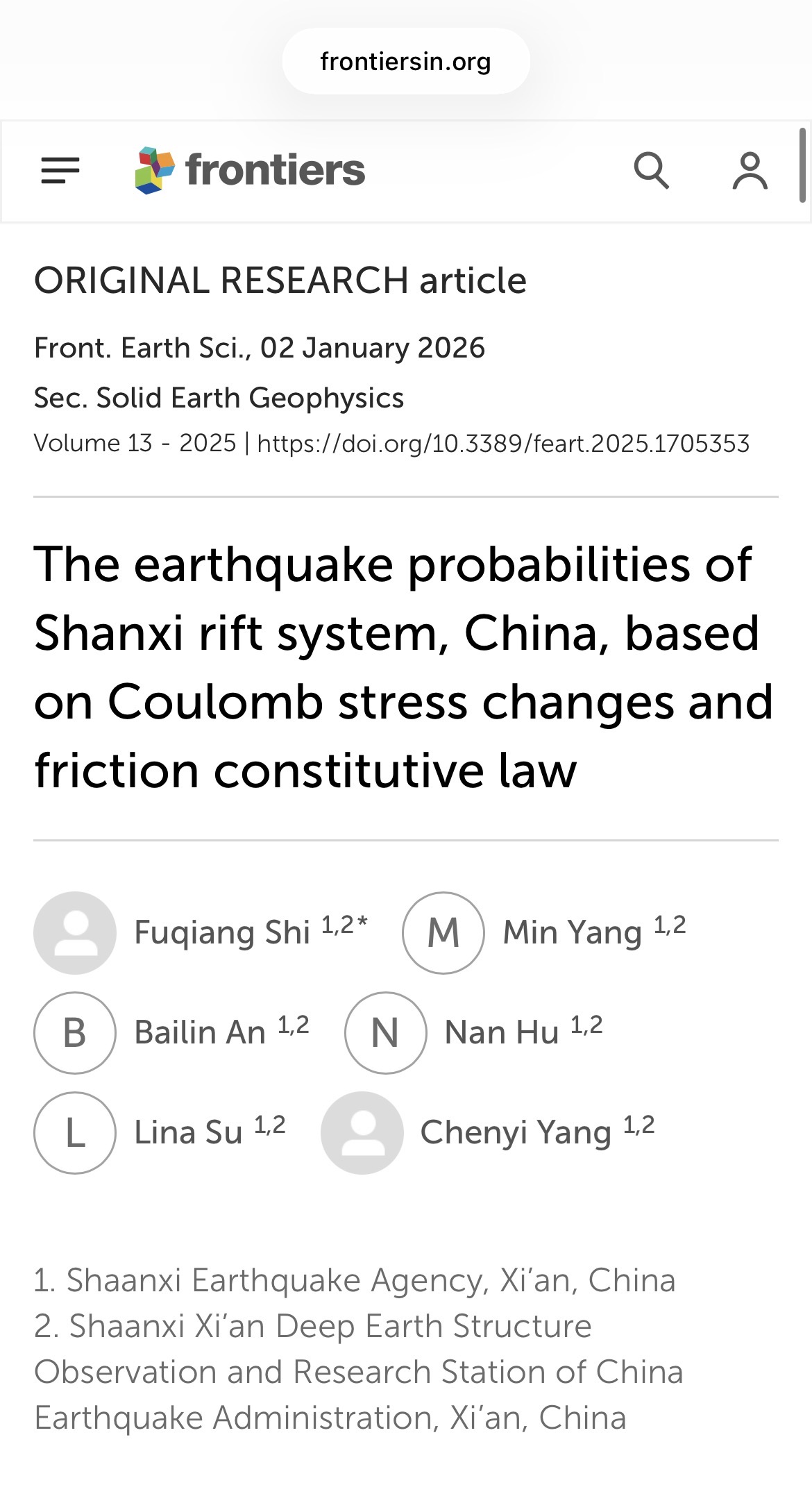
| Shi et al., Frontiers in Earth Science (2026) / Shi et al., Frontiers in Earth Science (2026) La probabilidad de Poisson acumulada para terremotos de magnitud ≥ 6 supera el 0,9 en los próximos 30 años, con las fallas de mayor riesgo concentradas en las cuencas de Datong y Taiyuan. Las fallas identificadas como prioritarias incluyen: Tianzhen, Yanggao-Tianzhen, Liulengshan y Yunzhongshan (cuenca de Datong), y la falla de Taigu (cuenca de Taiyuan). Todas ellas se sitúan en zonas de brecha sísmica histórica — es decir, sectores donde la energía tectónica lleva siglos sin liberarse. The cumulative Poisson probability for M ≥ 6 earthquakes exceeds 0.9 within the next 30 years, with the highest-risk faults concentrated in the Datong and Taiyuan basins. The priority faults identified include: Tianzhen, Yanggao-Tianzhen, Liulengshan, and Yunzhongshan (Datong basin), and the Taigu fault (Taiyuan basin). All of these are located within historical seismic gaps — sectors where tectonic energy has not been released for centuries. |
2.3 El aviso del 17 de julio de 2025 / The Warning of July 17, 2025
ES — El 17 de julio de 2025 a las 16:41h (CEST), la autora publicó en la cuenta @SUENKGIFT (nombre de usuario en ese momento: @SUENKGIFT_LVIT) el siguiente aviso:
EN — On July 17, 2025 at 16:41h (CEST), the author published the following warning on the @SUENKGIFT account (username at that time: @SUENKGIFT_LVIT):
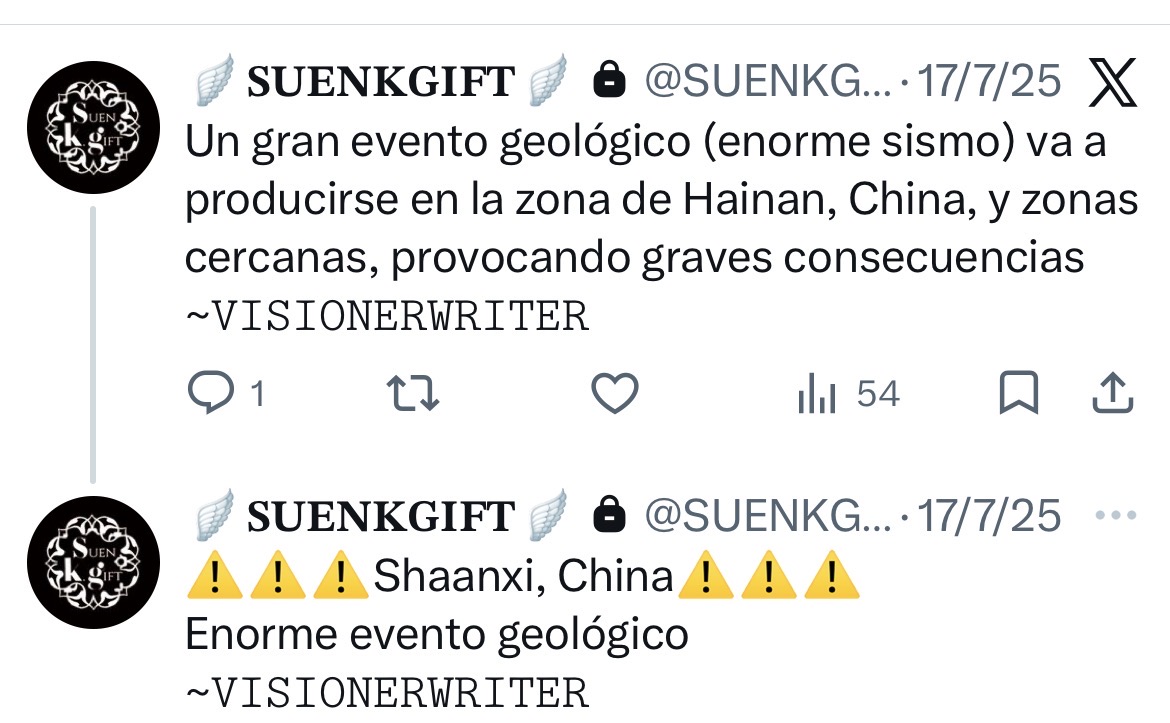
| @SUENKGIFT · 17/7/2025 · 16:41h CEST · 42 visualizaciones verificadas / @SUENKGIFT · 17/7/2025 · 16:41h CEST · 42 verified views ⚠️⚠️⚠️ Shaanxi, China ⚠️⚠️⚠️ Enorme evento geológico ~VISIONERWRITER ⚠️⚠️⚠️ Shaanxi, China ⚠️⚠️⚠️ Enormous geological event ~VISIONERWRITER |
ES — Este tweet se publicó en el mismo hilo que el aviso previo sobre «Hainan, China» del mismo día 17 de julio de 2025. La doble mención (Hainan + Shaanxi) en una sola sesión de avisos adquiere relevancia geológica cuando se verifica que ambas zonas comparten dependencia tectónica estructural a través del mecanismo de tectónica de escape derivado de la colisión entre las placas de la India y Eurasia.
EN — This tweet was published in the same thread as the prior warning about ‘Hainan, China’ issued on the same date of July 17, 2025. The dual mention (Hainan + Shaanxi) in a single warning session acquires geological relevance when it is verified that both zones share structural tectonic dependence through the escape tectonics mechanism derived from the India-Eurasia plate collision.
3. CADENA TEMPORAL DOCUMENTADA / DOCUMENTED TEMPORAL CHAIN
| FECHA / DATE DATE | EVENTO / EVENT EVENT | SIGNIFICADO / MEANING MEANING |
| ES — 17/11/2017 · 14:10h EN — Nov 17, 2017 · 14:10h | ES — @SUENKGIFT: ⚠️ IMPLOSIÓN MAGMÁTICA / ISOSTASIA ⚠️ EN — @SUENKGIFT: ⚠️ MAGMATIC IMPLOSION / ISOSTASY ⚠️ | ES — Primera publicación pública vinculando extracción de recursos del interior terrestre con desequilibrio isostático y riesgo sistémico planetario. Anterioridad: 8,5 años respecto al aviso de Shanxi. EN — First public publication linking extraction of Earth’s interior resources to isostatic imbalance and systemic planetary risk. Precedence: 8.5 years before the Shanxi warning. |
| ES — 17/11/2017 · 14:24h EN — Nov 17, 2017 · 14:24h | ES — @SUENKGIFT: ⚠️ BIG CRUNCH ⚠️ (Big Bounce Cycle) EN — @SUENKGIFT: ⚠️ BIG CRUNCH ⚠️ (Big Bounce Cycle) | ES — Publicación del concepto de colapso sistémico entrópico (Big Crunch) vinculado al marco IMPLOSIÓN MAGMÁTICA / ISOSTASIA. Antecede al CASO MAESTRO III (Degradación Entrópica Irreversible). EN — Publication of the systemic entropic collapse concept (Big Crunch) linked to the MAGMATIC IMPLOSION / ISOSTASY framework. Precedes MASTER CASE III (Irreversible Entropic Degradation). |
| ES — 14/6/2019 EN — Jun 14, 2019 | ES — @LVITSKG: Placa de Nazca → Chile, California, Alaska, Australia, Nueva Zelanda, Hawaii, Indonesia, Himalaya, Japón. EN — @LVITSKG: Nazca plate → Chile, California, Alaska, Australia, New Zealand, Hawaii, Indonesia, Himalayas, Japan. | ES — Respuesta directa a @USGSVolcanoes. Mapa geográfico completo derivado de PROPTER RETRO. Incluye explícitamente el Himalaya. La misma cadena de zonas que en 2026 comparte el patrón de inversión en geotermia y minerales radiactivos. EN — Direct response to @USGSVolcanoes. Complete geographic map derived from PROPTER RETRO. Explicitly includes the Himalayas. The same chain of zones that in 2026 shares the pattern of investment in geothermal and radioactive minerals. |
| ES — 17/7/2025 · ~16:30h EN — Jul 17, 2025 · ~16:30h | ES — @SUENKGIFT: Hainan, China — Enorme evento geológico (sismo) EN — @SUENKGIFT: Hainan, China — Enormous geological event (earthquake) | ES — Primer aviso de la sesión del 17/7/2025. Hainan: margen oceánico sur de China, zona de dependencia tectónica con el SRS. EN — First warning of the Jul 17, 2025 session. Hainan: southern oceanic margin of China, zone of tectonic dependence with the SRS. |
| ES — 17/7/2025 · 16:41h EN — Jul 17, 2025 · 16:41h | ES — @SUENKGIFT: ⚠️ Shaanxi, China ⚠️ — Enorme evento geológico EN — @SUENKGIFT: ⚠️ Shaanxi, China ⚠️ — Enormous geological event | ES — Segundo aviso. Shaanxi: extremo suroeste del Sistema de Rift de Shanxi (cuenca de Weihe). Los dos avisos (Hainan + Shaanxi) en la misma sesión describen los dos extremos del mismo proceso continental. EN — Second warning. Shaanxi: southwestern edge of the Shanxi Rift System (Weihe basin). Both warnings (Hainan + Shaanxi) in the same session describe the two ends of the same continental process. |
| ES — 22/12/2025 EN — Dec 22, 2025 | ES — Sismo M 4,2 (inicialmente estimado 4,6) en Lingqiu, cuenca de Datong. Profundidad: 8 km. EN — M 4.2 earthquake (initially estimated 4.6) in Lingqiu, Datong basin. Depth: 8 km. | ES — Epicentro en una de las zonas de mayor flujo térmico del SRS. Coincide con las fallas de máximo riesgo identificadas por Shi et al. (2026). Intervalo desde el aviso: 158 días. EN — Epicenter in one of the highest thermal-flux zones of the SRS. Coincides with the highest-risk faults identified by Shi et al. (2026). Interval from warning: 158 days. |
| ES — 2/1/2026 EN — Jan 2, 2026 | ES — Publicación: Shi et al. en Frontiers in Earth Science. Probabilidad ≥ 0,9 para M ≥ 6 en Datong y Taiyuan. EN — Publication: Shi et al. in Frontiers in Earth Science. Probability ≥ 0.9 for M ≥ 6 in Datong and Taiyuan. | ES — Validación científica institucional del nodo de riesgo señalado 169 días antes por el aviso de la autora. EN — Institutional scientific validation of the risk node identified 169 days earlier by the author’s warning. |
| ES — 9/1/2026 EN — Jan 9, 2026 | ES — China Daily: «China to step up earthquake preparedness efforts in 2026.» CEA activa Nivel III. Plan Quinquenal sismológico 2026–2030. EN — China Daily: ‘China to step up earthquake preparedness efforts in 2026.’ CEA activates Level III. Seismological Five-Year Plan 2026–2030. | ES — Respuesta institucional oficial del Estado chino al riesgo sísmico del SRS. Reconocimiento explícito de urgencia en las cuencas de Datong y Taiyuan. EN — Official institutional response of the Chinese State to the SRS seismic risk. Explicit acknowledgment of urgency in the Datong and Taiyuan basins. |
| ES — 18/2/2026 EN — Feb 18, 2026 | ES — Sismo M 4,3 cerca de Shanxi. 20:58h hora local. EN — M 4.3 earthquake near Shanxi. 20:58h local time. | ES — Segunda liberación de energía acumulada en el SRS desde el aviso del 17/7/2025. Intervalo desde el aviso: 216 días. EN — Second release of accumulated energy in the SRS since the Jul 17, 2025 warning. Interval from warning: 216 days. |
| ES — Febrero 2026 EN — February 2026 | ES — Sismo M 7,1 en el Mar de China Meridional (zona adyacente a Hainan). EN — M 7.1 earthquake in the South China Sea (zone adjacent to Hainan). | ES — Cumplimiento del primer aviso de la sesión del 17/7/2025 (Hainan). Confirma que la sesión de avisos describió los dos extremos del mismo proceso de transferencia de estrés. EN — Fulfillment of the first warning of the Jul 17, 2025 session (Hainan). Confirms that the warning session described both ends of the same stress-transfer process. |
| ES — 5/4/2026 EN — Apr 5, 2026 | ES — Sismo M 4,2 en Lüeyang, Shaanxi. Cuenca de Weihe (extremo suroeste del SRS). Profundidad: 10 km. EN — M 4.2 earthquake in Lüeyang, Shaanxi. Weihe basin (southwestern edge of the SRS). Depth: 10 km. | ES — Tercera liberación de energía en el SRS. La zona de Weihe es exactamente la que corresponde al aviso «Shaanxi» del 17/7/2025. Intervalo desde el aviso: 261 días. EN — Third energy release in the SRS. The Weihe zone corresponds exactly to the ‘Shaanxi’ warning of Jul 17, 2025. Interval from warning: 261 days. |
| ES — Abril 2026 EN — April 2026 | ES — 15.º Plan Quinquenal de Shanxi: explotación geotérmica en las cuencas de Datong (Tianzhen), Yanggao y Xinzhou como prioridad energética. EN — Shanxi’s 15th Five-Year Plan: geothermal exploitation in Datong (Tianzhen), Yanggao and Xinzhou basins as energy priority. | ES — Central geotérmica de Tianzhen: reservorios a 160 ºC a profundidades de 1.500–2.000 metros, conectada a la red en mayo 2026. Explotación activa sobre las fallas de mayor riesgo sísmico identificadas por Shi et al. EN — Tianzhen geothermal plant: 160 ºC reservoirs at depths of 1,500–2,000 metres, connected to the grid in May 2026. Active exploitation over the highest seismic-risk faults identified by Shi et al. |
4. ANÁLISIS DE CORRESPONDENCIAS / CORRESPONDENCE ANALYSIS
4.1 La lógica del atractor / The Logic of the Attractor
ES — El caso no documenta una correspondencia de evento puntual (aviso → terremoto al día siguiente), sino una correspondencia de tipo atractor: el aviso señala un nodo de riesgo sistémico activo, y la cadena de validaciones institucionales y eventos menores confirma que ese nodo está en proceso de liberación progresiva de energía acumulada.
EN — This case does not document a point-event correspondence (warning → earthquake the next day), but rather an attractor-type correspondence: the warning identifies an active systemic risk node, and the chain of institutional validations and minor events confirms that this node is undergoing progressive release of accumulated energy.
ES — Esta lógica es idéntica a la documentada en el CASO 028 (Kilauea 2018): el Atractor de Lorenz publicado el 8/11/2017 no predijo el Agung ese día, sino que señaló el nodo del sistema antes de que la implosión magmática del Kilauea se produjera seis meses después. El intervalo no invalida la correspondencia: es parte del patrón del atractor.
EN — This logic is identical to that documented in CASE 028 (Kilauea 2018): the Lorenz Attractor published on Nov 8, 2017 did not predict Agung that day, but rather identified the system node before the magmatic implosion of Kilauea occurred six months later. The interval does not invalidate the correspondence: it is part of the attractor pattern.
4.2 Conexión tectónica Shanxi–Hainan / Shanxi–Hainan Tectonic Connection
ES — La doble mención Hainan + Shaanxi en el aviso del 17/7/2025 tiene correspondencia geológica verificada: ambas zonas son los dos extremos del mismo proceso continental impulsado por la colisión India-Eurasia (40–50 mm/año). Shanxi representa el estiramiento extensional de la corteza en el norte; Hainan representa la fragmentación y deriva en el margen oceánico del sur. El sismo M 7,1 en el Mar de China Meridional en febrero de 2026 confirma la activación del nodo sur identificado en el aviso.
EN — The dual mention of Hainan + Shaanxi in the Jul 17, 2025 warning has verified geological correspondence: both zones are the two ends of the same continental process driven by the India-Eurasia collision (40–50 mm/year). Shanxi represents extensional crustal stretching in the north; Hainan represents fragmentation and drift at the southern oceanic margin. The M 7.1 earthquake in the South China Sea in February 2026 confirms the activation of the southern node identified in the warning.
4.3 El vector geotérmico y radiactivo como factor de riesgo adicional / The Geothermal and Radioactive Vector as Additional Risk Factor
ES — La extracción geotérmica activa sobre las cuencas de Datong y Taiyuan introduce un factor de riesgo adicional que la ciencia institucional reconoce de forma disociada pero no ha integrado sistémicamente. Los puntos verificados son:
EN — Active geothermal extraction over the Datong and Taiyuan basins introduces an additional risk factor that institutional science recognizes in dissociated form but has not yet integrated systemically. The verified points are:
| Síntesis verificada — Fuentes: Shi et al. 2026 / MDPI 2026 / NCBI 2024 / USGS / Verified synthesis — Sources: Shi et al. 2026 / MDPI 2026 / NCBI 2024 / USGS (1) Los elementos radiactivos — uranio, torio, potasio — generan el 50% del calor radiogénico interno de la Tierra, impulsan la convección del manto y, por tanto, el movimiento de las placas tectónicas. (2) Estos elementos no pueden retornar al interior terrestre una vez extraídos, dada su afinidad geoquímica con la corteza. (3) La extracción de fluidos geotérmicos en zonas de falla activa altera la presión de poro y puede inducir sismicidad, como está documentado en Pohang (Corea, 2017), The Geysers (California, +50 años) y el Campo Geotérmico de Salton Sea. (4) En Tianzhen y Yanggao se han registrado temperaturas superiores a 100 ºC a tan solo 100 metros de profundidad, lo que indica cámaras magmáticas activas en la corteza media-superior. (1) Radioactive elements — uranium, thorium, potassium — generate 50% of Earth’s internal radiogenic heat, drive mantle convection and, therefore, plate movement. (2) These elements cannot return to Earth’s interior once extracted, given their geochemical affinity with the crust. (3) Extraction of geothermal fluids in active fault zones alters pore pressure and can induce seismicity, as documented in Pohang (Korea, 2017), The Geysers (California, 50+ years), and the Salton Sea Geothermal Field. (4) In Tianzhen and Yanggao, temperatures exceeding 100 ºC have been recorded at just 100 metres depth, indicating active magmatic chambers in the mid-upper crust. |
ES — La tesis formulada por la autora en noviembre de 2017 — IMPLOSIÓN MAGMÁTICA / ISOSTASIA — integra sistémicamente estos tres niveles: la extracción radiactiva irreversible reduce el calor que mueve las placas; la extracción geotérmica activa altera las presiones en fallas sísmicas ya cargadas; el resultado acumulativo es un desequilibrio isostático progresivo que la ciencia institucional aún no ha formalizado como modelo unificado.
EN — The thesis formulated by the author in November 2017 — MAGMATIC IMPLOSION / ISOSTASY — systematically integrates these three levels: irreversible radioactive extraction reduces the heat that moves the plates; active geothermal extraction alters pressures in already-loaded seismic faults; the cumulative result is a progressive isostatic imbalance that institutional science has not yet formalised as a unified model.
5. TABLA DE CORRESPONDENCIAS VERIFICADAS / VERIFIED CORRESPONDENCES TABLE
| PUBLICACIÓN / PUBLICATION PUBLICATION | FECHA AVISO / WARNING DATE WARNING DATE | EVENTO VERIFICADO / VERIFIED EVENT VERIFIED EVENT | ESTADO / STATUS STATUS |
| ES — ⚠️ IMPLOSIÓN MAGMÁTICA / ISOSTASIA EN — ⚠️ MAGMATIC IMPLOSION / ISOSTASY | ES — 17/11/2017 · @SUENKGIFT EN — Nov 17, 2017 · @SUENKGIFT | ES — Marco teórico confirmado por sismicidad inducida geotérmica (Pohang 2017, The Geysers 50+ años, Salton Sea). Artículo Frontiers 2026 valida el nodo de riesgo. EN — Theoretical framework confirmed by geothermal-induced seismicity (Pohang 2017, The Geysers 50+ years, Salton Sea). Frontiers 2026 paper validates the risk node. | ES — ✓ VERIFICADO EN — ✓ VERIFIED |
| ES — Placa de Nazca → Himalaya, Indonesia, Japón, Chile, California, Alaska, Australia, Nueva Zelanda, Hawaii EN — Nazca plate → Himalayas, Indonesia, Japan, Chile, California, Alaska, Australia, New Zealand, Hawaii | ES — 14/6/2019 · @LVITSKG EN — Jun 14, 2019 · @LVITSKG | ES — Todas las zonas mencionadas confirmadas en 2026 como nodos simultáneos de inversión geotérmica + exploración de minerales radiactivos. EN — All zones mentioned confirmed in 2026 as simultaneous nodes of geothermal investment + radioactive mineral exploration. | ES — ✓ VERIFICADO EN — ✓ VERIFIED |
| ES — ⚠️ Shaanxi, China ⚠️ — Enorme evento geológico EN — ⚠️ Shaanxi, China ⚠️ — Enormous geological event | ES — 17/7/2025 · 16:41h · @SUENKGIFT EN — Jul 17, 2025 · 16:41h · @SUENKGIFT | ES — M 4,2 Lingqiu/Datong (22/12/2025) · M 4,3 Shanxi (18/2/2026) · M 4,2 Lüeyang/Shaanxi (5/4/2026) · Frontiers paper (2/1/2026) · Plan Quinquenal China (9/1/2026) EN — M 4.2 Lingqiu/Datong (Dec 22, 2025) · M 4.3 Shanxi (Feb 18, 2026) · M 4.2 Lüeyang/Shaanxi (Apr 5, 2026) · Frontiers paper (Jan 2, 2026) · China Five-Year Plan (Jan 9, 2026) | ES — ✓ VERIFICADO (nodo activo) EN — ✓ VERIFIED (active node) |
| ES — Hainan, China — Enorme evento geológico (sismo) EN — Hainan, China — Enormous geological event (earthquake) | ES — 17/7/2025 · ~16:30h · @SUENKGIFT EN — Jul 17, 2025 · ~16:30h · @SUENKGIFT | ES — M 7,1 Mar de China Meridional (febrero 2026). Nodo Hainan: fragmentación y deriva en margen oceánico sur, extremo opuesto del proceso Shanxi. EN — M 7.1 South China Sea (February 2026). Hainan node: fragmentation and drift at the southern oceanic margin, the opposite end of the Shanxi process. | ES — ✓ VERIFICADO EN — ✓ VERIFIED |
6. CONEXIÓN CON LOS MANUSCRITOS / CONNECTION TO THE MANUSCRIPTS
6.1 PROPTER RETRO (L-37-2012) — El profesor Thomas / PROPTER RETRO (L-37-2012) — Professor Thomas
ES — El personaje del «profesor Thomas» en PROPTER RETRO (2012) expone la mecánica de transferencia de presión entre la placa del Pacífico, la placa de Nazca y la placa Filipina como sistema de equilibrios acumulados. La misma lógica — placas actuando como válvulas de presión interconectadas — describe el mecanismo que vincula Shanxi (rift extensional, norte de China) con Hainan y el Agung (subducción, sur y sureste de Asia). La autora publicó el fragmento del «profesor Thomas» en Twitter el 29/10/2019, un año después del Kilauea y cuatro meses antes del aviso del coronavirus.
EN — The character of ‘Professor Thomas’ in PROPTER RETRO (2012) explains the pressure-transfer mechanics between the Pacific plate, the Nazca plate, and the Philippine plate as a system of accumulated balances. The same logic — plates acting as interconnected pressure valves — describes the mechanism linking Shanxi (extensional rift, northern China) to Hainan and Agung (subduction, southern and southeastern Asia). The author published the ‘Professor Thomas’ passage on Twitter on Oct 29, 2019, one year after Kilauea and four months before the coronavirus warning.
6.2 CASO 029 IM I — Implosión Magmática / Isostasia / CASE 029 IM I — Magmatic Implosion / Isostasy
ES — El CASO 029 IM I documenta la cadena de publicaciones del 17/11/2017 sobre isostasia e implosión magmática, con la verificación del Agung (noviembre 2017) y el Kilauea (mayo 2018). El CASO 024 IM II extiende esa cadena: el mismo marco teórico (isostasia + extracción + desequilibrio sistémico) se aplica ahora al Sistema de Rift de Shanxi, con la diferencia de que la validación no es un evento volcánico único sino una acumulación de sismos menores, estudios científicos y decisiones de política energética estatal que confirman el nodo de riesgo.
EN — CASE 029 IM I documents the chain of publications of Nov 17, 2017 on isostasy and magmatic implosion, with the verification of Agung (November 2017) and Kilauea (May 2018). CASE 024 IM II extends that chain: the same theoretical framework (isostasy + extraction + systemic imbalance) is now applied to the Shanxi Rift System, with the difference that validation is not a single volcanic event but an accumulation of minor earthquakes, scientific studies, and state energy policy decisions that confirm the risk node.
7. NOTAS Y OBSERVACIONES / NOTES AND OBSERVATIONS
| Nota metodológica MT-001 v4 / Methodological Note MT-001 v4 NOTA METODOLÓGICA: El aviso del 17/7/2025 no describió un evento puntual sino un nodo de riesgo activo. La metodología MT-001 v4 («Publicar, Silenciar, Proteger») opera mediante avisos que señalan zonas de acumulación de riesgo sistémico, no mediante predicciones de fecha y magnitud exactas. La cadena de validaciones posteriores (Frontiers in Earth Science, China Daily, sismos de diciembre 2025 / febrero 2026 / abril 2026) confirma que el nodo señalado está en proceso de liberación de energía. El aviso permanece activo: la probabilidad ≥ 0,9 para M ≥ 6 en Datong y Taiyuan en los próximos 30 años indica que el proceso no ha concluido. METHODOLOGICAL NOTE: The Jul 17, 2025 warning did not describe a point event but an active risk node. The MT-001 v4 methodology (‘Publish, Silence, Protect’) operates through warnings that identify zones of systemic risk accumulation, not through predictions of exact dates and magnitudes. The subsequent chain of validations (Frontiers in Earth Science, China Daily, earthquakes of Dec 2025 / Feb 2026 / Apr 2026) confirms that the identified node is undergoing energy release. The warning remains active: the ≥ 0.9 probability for M ≥ 6 in Datong and Taiyuan within 30 years indicates that the process has not concluded. |
| Nota de riesgo activo / Active Risk Note NOTA SOBRE LA EXTRACCIÓN GEOTÉRMICA EN DATONG: El 15.º Plan Quinquenal de Shanxi (anunciado en abril de 2026) prioriza la explotación geotérmica de las cuencas de Datong y Tianzhen — exactamente las fallas de mayor riesgo sísmico según Shi et al. (2026). La Central Geotérmica de Tianzhen opera sobre reservorios a 160 ºC a profundidades de 1.500–2.000 metros y completó su conexión a la red en mayo de 2026. El Parque Industrial de Yanggao implementa re-inyección total de fluidos para «evitar la sismicidad inducida» — reconocimiento explícito del riesgo. Esta situación es análoga al caso Pohang (CASO 029-C IM I): explotación geotérmica en zona de falla activa con alta energía acumulada. NOTE ON GEOTHERMAL EXTRACTION IN DATONG: Shanxi’s 15th Five-Year Plan (announced in April 2026) prioritises geothermal exploitation of the Datong and Tianzhen basins — exactly the highest seismic-risk faults according to Shi et al. (2026). The Tianzhen Geothermal Plant operates on reservoirs at 160 ºC at depths of 1,500–2,000 metres and completed its grid connection in May 2026. The Yanggao Industrial Park implements total fluid re-injection to ‘avoid induced seismicity’ — explicit acknowledgment of the risk. This situation is analogous to the Pohang case (CASE 029-C IM I): geothermal exploitation in an active fault zone with high accumulated energy. |
8. FICHA TÉCNICA DEL DOCUMENTO / DOCUMENT TECHNICAL RECORD
| CAMPO FIELD | DATO DATA |
| ES — CÓDIGO / CODE EN — CODE | ES — CASO 024 IM II — v1 · 02/05/2026 EN — CASE 024 IM II — v1 · May 2, 2026 |
| ES — TIMESTAMP EN — TIMESTAMP | ES — Sábado 2 de mayo de 2026 · 06:04h–07:30h CEST · Cataluña EN — Saturday, May 2, 2026 · 06:04h–07:30h CEST · Catalonia |
| ES — VERSIÓN IM II EN — IM II VERSION | ES — v26 · 29 casos / 13 addenda (IM II v25 como base) EN — v26 · 29 cases / 13 addenda (IM II v25 as base) |
| ES — REGISTROS / REGISTRATIONS EN — REGISTRATIONS | ES — L-49-2011 · L-37-2012 · L-126-2012 · L-3-2014 (RCPIC + CEDRO) EN — L-49-2011 · L-37-2012 · L-126-2012 · L-3-2014 (RCPIC + CEDRO) |
| ES — FUENTES PRIMARIAS EN — PRIMARY SOURCES | ES — Shi et al. (2026), Frontiers in Earth Science · China Daily (9/1/2026) · VolcanoDiscovery / EarthquakeList.org · USGS · MDPI (2026) · NCBI/NIH · EBSCO (Isostasy) · Centauri Dreams (2020) EN — Shi et al. (2026), Frontiers in Earth Science · China Daily (Jan 9, 2026) · VolcanoDiscovery / EarthquakeList.org · USGS · MDPI (2026) · NCBI/NIH · EBSCO (Isostasy) · Centauri Dreams (2020) |
| ES — PUBLICACIONES CLAVE EN — KEY PUBLICATIONS | ES — @SUENKGIFT 17/11/2017 (14:10h + 14:24h) · @LVITSKG 14/6/2019 · @SUENKGIFT 17/7/2025 (16:41h) EN — @SUENKGIFT Nov 17, 2017 (14:10h + 14:24h) · @LVITSKG Jun 14, 2019 · @SUENKGIFT Jul 17, 2025 (16:41h) |
| ES — FORMATO EN — FORMAT | ES — DOCX bilingüe ES/EN — Formato estándar Inventario Maestro II EN — Bilingual ES/EN DOCX — Standard Master Inventory II format |
★ ★ ★
«Nada es Casual, Todo se Verá / Yo solo aviso.»
‘Nothing is Coincidence, Everything Will Be Seen / I Only Warn.’
Suen K. Gift (Nieves/Neus) · LVITSKG · VISIONERWRITER
CASO 024 IM II · v1 · Sábado 2 de mayo de 2026 · 06:04h–07:30h CEST
suenkgift.com
★ ★ ★